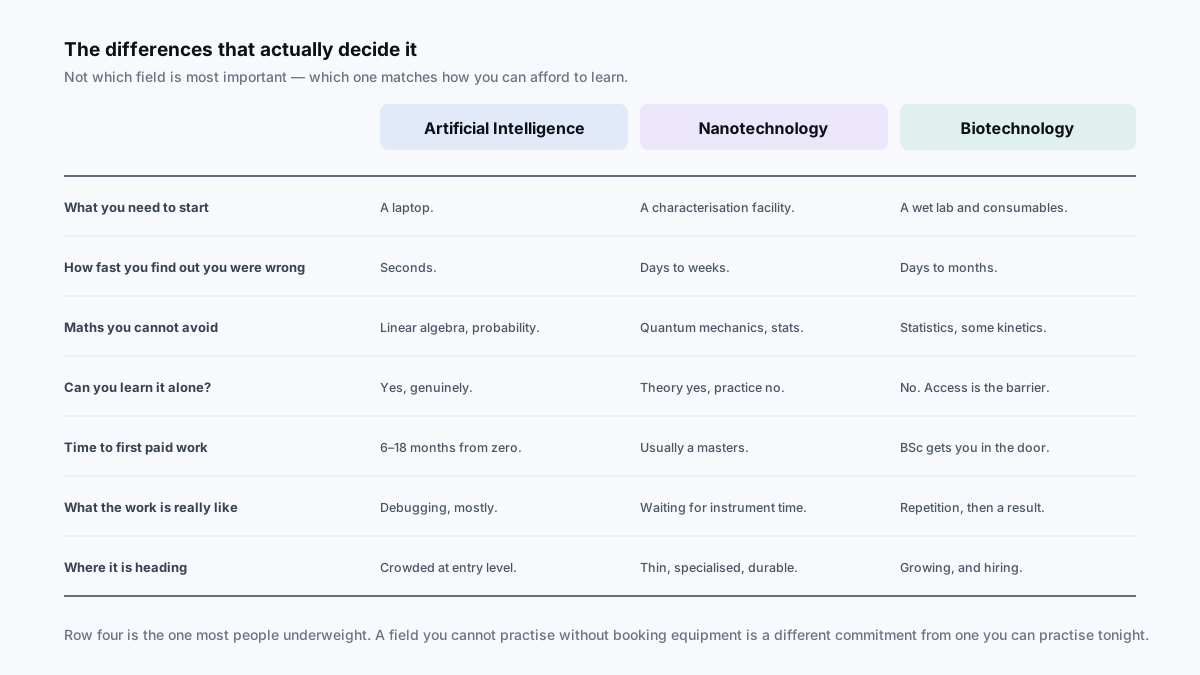
The decision usually comes down to access and feedback speed rather than interest. AI can be practised tonight on a laptop with feedback in seconds; nanotechnology and biotechnology require instrument or bench time and return feedback in days to months. If you cannot get facility access, that constraint outranks every other consideration.
- Access outranks interest. A field you cannot practise without booking equipment is a different commitment from one you can practise tonight.
- Feedback speed shapes how fast you improve. Seconds in AI, days to weeks in nano, days to months in bio.
- Entry-level AI is crowded. The low barrier that makes it learnable also makes it competitive.
- You are not choosing for life. The intersections are where the least competition is, and they need a first domain to start from.
The wrong question and the right one
"Which field has the most potential?" is the question people ask and it has no useful answer. All three are large, all three are growing, and none of them will be finished during your career.
The question that actually decides it is narrower: which one can you practise, given the resources you have, at a rate fast enough to keep going?
Motivation is a real input, not a soft one. A field where you can attempt something on a Tuesday evening and know by Tuesday night whether it worked builds competence differently from one where the answer arrives in three weeks.
What you need to start
AI: a laptop. Every major framework is free, datasets are public, and a modest machine trains a useful model. Cloud compute for larger work costs less than a textbook did.
Nanotechnology: access to a characterisation facility. You can read about TEM images indefinitely and you cannot learn to read one without operating the instrument, because most of the skill is recognising artefacts.
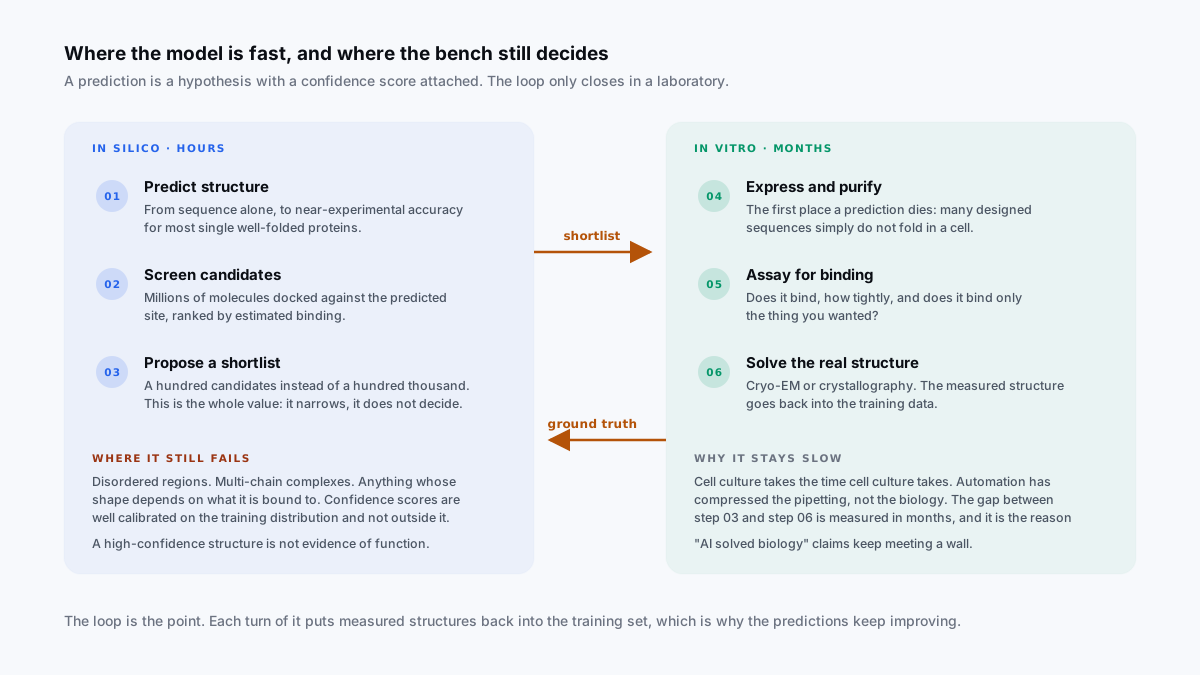
Biotechnology: a wet lab and consumables. Pipetting is a physical skill, sterile technique is a physical skill, and neither is acquired from a video.
This asymmetry is the single largest practical difference between the three and it is routinely omitted from careers advice.
How fast you find out you were wrong
In AI the loop is seconds to hours. Change something, retrain, see the number move. Over a year this compounds into an enormous number of attempts.
In nanotechnology it is days to weeks — synthesis, then instrument time, which is booked. In biotechnology it is days to months, because cell culture takes what cell culture takes.
This is not a quality judgement about the fields. It is a fact about how you will experience learning them, and it favours different temperaments. Some people are energised by fast iteration; others do better with long, careful experiments where thinking time is built in.
The maths you cannot route around
Every one of the three has a mathematical floor, and they are different floors.
AI needs linear algebra and probability to a working level. Not to use a library — to debug a model that trains without learning anything, which will happen in your first month.
Nanotechnology needs quantum mechanics for anything involving confinement or spectroscopy, plus statistics for size distributions. This is the heaviest physics load of the three.
Biotechnology needs statistics above all — experimental design, controls, and what a p-value does and does not say. Less continuous mathematics than the others, and more of the kind you will misuse if you skip it.
Where the jobs actually are
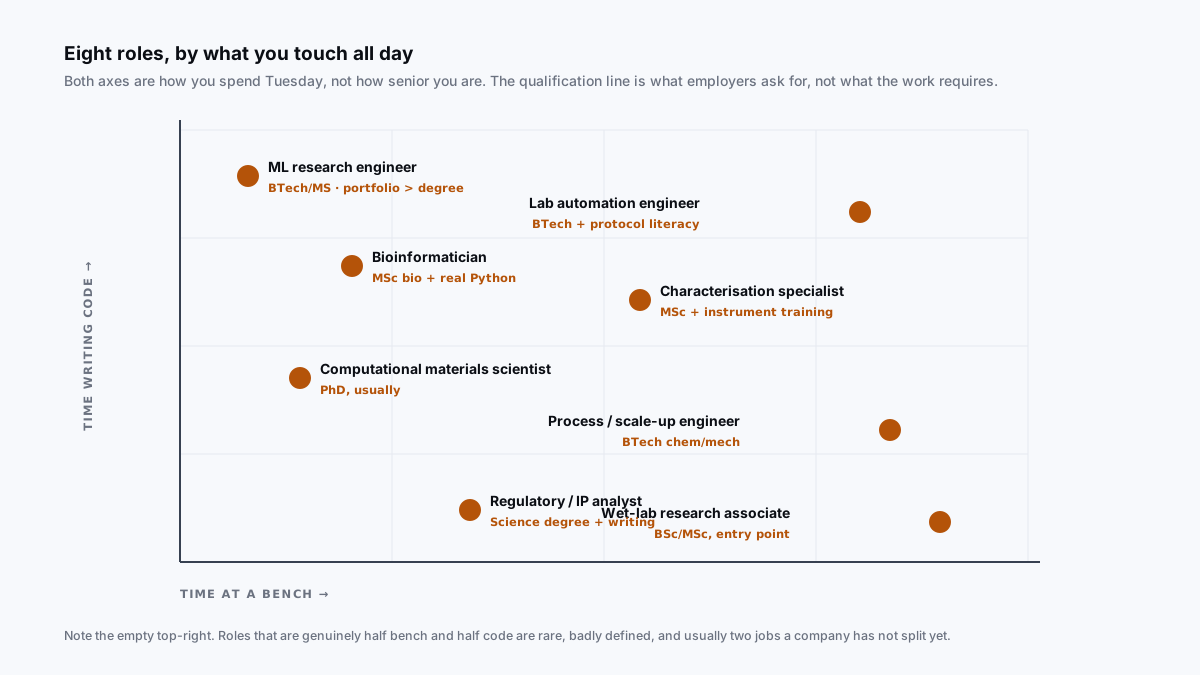
Entry-level machine learning is crowded, and for a structural reason: the low barrier that makes it learnable makes it competitive. A junior position attracts hundreds of applicants with similar portfolios.
Nanotechnology roles are fewer, more specialised and considerably less contested. Characterisation and scale-up in particular are hiring and are almost never chosen deliberately.
Biotechnology is growing steadily and a BSc still opens the door to a research associate position — the clearest entry-level path of the three.
Worth stating plainly: fewer roles is not the same as worse prospects. Ten applicants for five nanotechnology positions is a better position than four hundred for twenty AI ones.
How to actually decide
Three questions, in this order.
Can you get facility access in the next six months? If not — no university lab, no programme with instrument time — the choice is effectively made. Start with AI, because it is the one you can start with.
Does slow feedback frustrate you or suit you? Answer honestly rather than aspirationally. Someone who needs to see progress weekly will struggle with a three-week culture, and that is a fact about you rather than a failing.
What do you want to be true in five years? If the answer involves building things people use, AI and biotechnology are closer to product. If it involves understanding something properly, nanotechnology sits closest to fundamental physics.
You are not choosing for life
The most useful thing to know is that this decision is smaller than it feels.
The interesting work increasingly sits at intersections — machine learning applied to biology, computational materials discovery, nanoscale drug delivery. Every one of those needs someone who knows one domain properly and enough of another to collaborate.
The people at those intersections did not start there. They started somewhere and moved. Choose the one you can practise, get genuinely good at it, and let the second one arrive when a problem requires it.
Sources & further reading
Common questions
Can I learn two at once?
Not well at the start. Get to competence in one first — the second is much easier from a position of knowing what competence feels like, and much harder when you are still unsure in both.
What if my degree is in the wrong subject?
It matters less than you think for computational work and more for wet-lab work, where access is what a degree is really providing. People move into machine learning from physics, mathematics and engineering routinely.
Is it too late to start?
For AI, no — the field's own tools change fast enough that everyone is regularly a beginner at something. For wet-lab work the constraint is access rather than age, and it is worth solving that first.