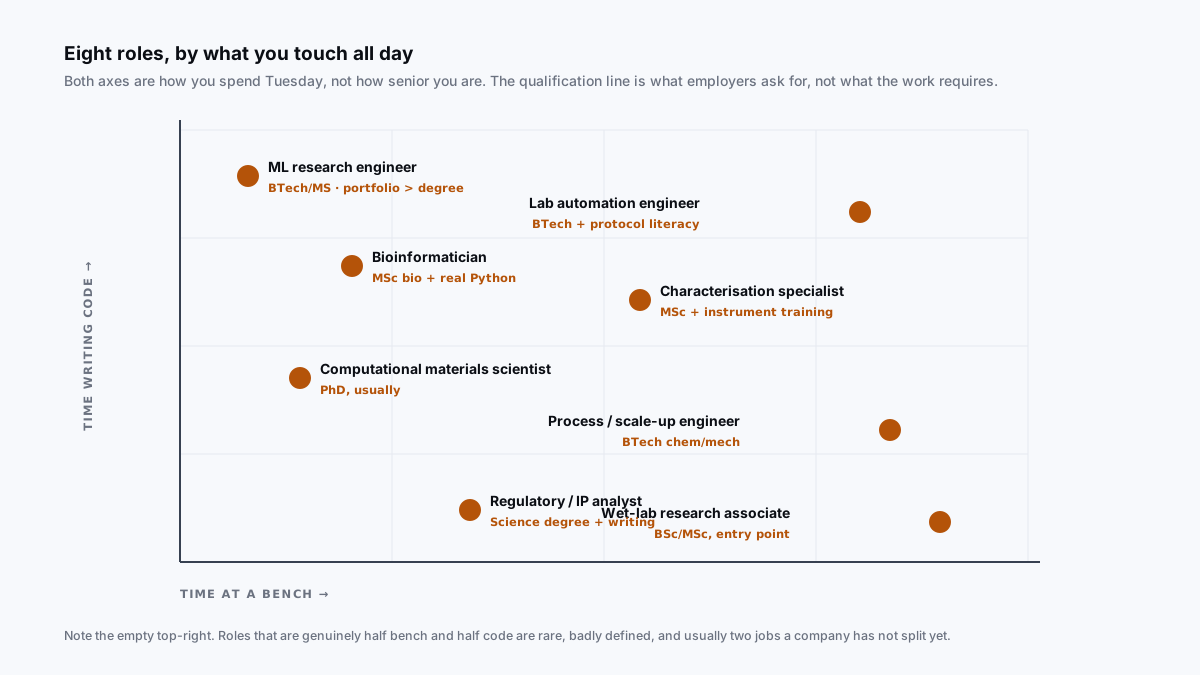
Deep-science roles divide most usefully along two axes: how much of your day is spent at a bench and how much is spent writing code. Roles that are genuinely half of each are rare and usually represent two jobs a company has not yet separated. The qualification employers ask for is frequently not the one the work requires, and the gap is largest at the computational end.
- Bench time and code time are the axes that matter. They predict daily experience better than domain or seniority does.
- The stated qualification is often not the required one. Most computational roles weigh demonstrated work above degree level; most wet-lab roles do not.
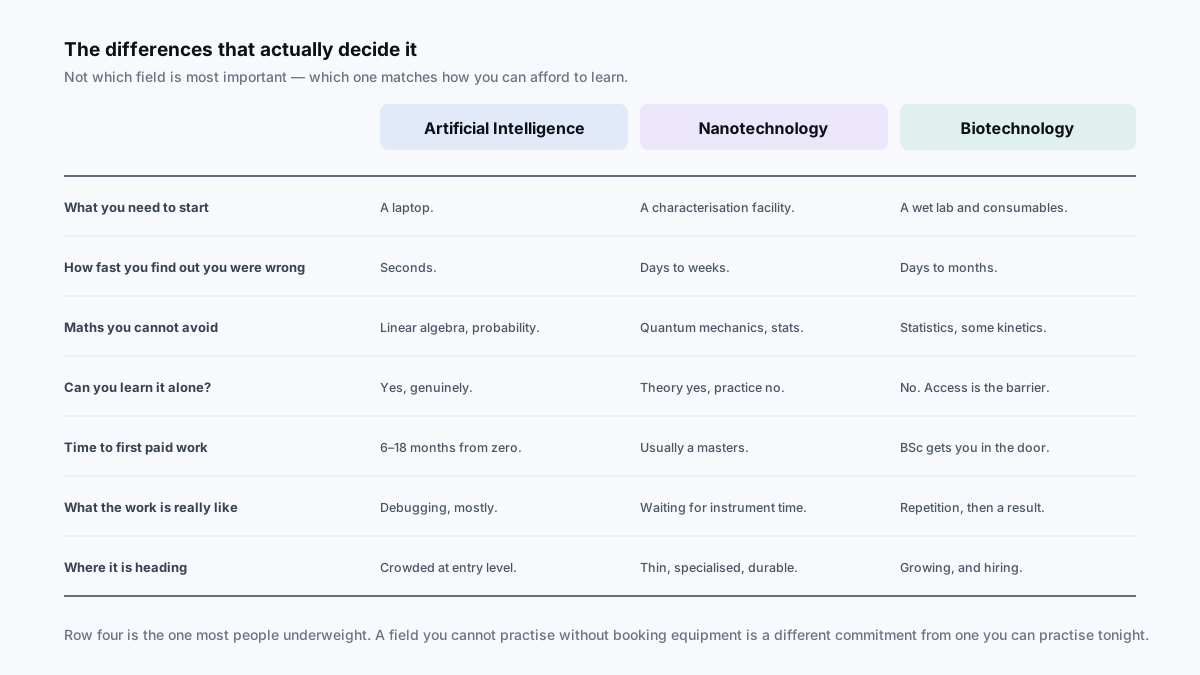
- Access is the real barrier in nano and bio. You cannot practise without instrument or bench time, which is why programme choice matters more there.
- The least-discussed roles are the least crowded. Characterisation, scale-up and regulatory work are hiring and almost nobody applies deliberately.
The question students actually ask
Careers advice in deep science tends to describe fields rather than jobs: nanotechnology is exciting, biotechnology is growing, AI is everywhere. None of that helps someone decide what to do, because you do not do a field. You do a job, on a Tuesday, with specific tools, and either the shape of that day suits you or it does not.
So here are eight real roles, described by the day.
The computational end
Machine learning research engineer
The day: reading papers, implementing something from one, and discovering it does not reproduce. Long stretches of debugging training runs that fail silently. Occasional experiments that work.
Asked for: BTech or MS. Actually weighs: a portfolio of work where you handled real, messy data and can explain your choices. This is the role where demonstrated work most clearly outranks credentials.
Bioinformatician
The day: pipelines, file formats, and statistics. A great deal of the work is getting data from one tool's output into another tool's input without silently corrupting it. The biology arrives in short, high-value bursts.
Asked for: MSc in a life science plus genuine Python or R. The common failure: people who have one half and assume the other is a weekend's work.
Computational materials scientist
The day: setting up simulations, waiting for cluster time, and interpreting results against experimental data that rarely agrees exactly. Heavier physics than the other two.
Asked for: usually a PhD, and here that is genuine rather than a filter — the judgement about which approximations are safe is hard to acquire otherwise.
The middle
Characterisation specialist
The day: running TEM, AFM or XRD on other people's samples, and telling them what their material actually is rather than what they hoped. Substantial instrument time, substantial image interpretation.
Asked for: MSc plus instrument training. Why it is underrated: the skill transfers across every materials employer, the instruments are expensive enough that trained operators are scarce, and almost nobody chooses it deliberately.
Lab automation engineer
The day: programming liquid handlers, integrating instruments that were not designed to talk to each other, and translating a biologist's protocol into something a robot executes identically every time.
Asked for: BTech plus enough protocol literacy to know why a step exists. Growing quickly, and sits in a gap that neither pure engineers nor pure biologists usually fill.
The bench end
Process and scale-up engineer
The day: taking something that works in a flask and making it work in a reactor. Mixing, heat transfer, yield, cost per gram. Deeply unglamorous and the stage where most materials projects actually die.
Asked for: chemical or mechanical engineering. Why it matters: discovery is oversupplied with people and scale-up is not.
Wet-lab research associate
The day: executing protocols, keeping cell lines alive, and recording everything. Repetitive by design, because reproducibility requires it.
Asked for: BSc or MSc. This is the standard entry point into biotechnology and the role where hands-on competence is established.
Regulatory and IP analyst
The day: reading patents, drafting submissions, and working out whether a planned experiment infringes something. Science degree plus a great deal of careful writing.
Why students never consider it: nobody mentions it. It pays well, it is stable, and it needs people who genuinely understand the science rather than lawyers who have read a summary.
Two things worth knowing before choosing
Access is the real constraint
You can practise machine learning tonight with a laptop. You cannot practise nanotechnology or wet-lab biology without a facility, and that asymmetry should weigh heavily on how you choose a programme. For the computational path, what you build matters more than where you studied. For the other two, access to instruments and bench time is most of what a programme is actually providing.
The crowding is uneven
Entry-level machine learning is crowded — the low barrier that makes it learnable also makes it competitive. Characterisation, scale-up and regulatory work are not crowded, are hiring, and are almost never chosen on purpose. That gap is an opportunity for anyone willing to take a role that does not sound impressive at a family dinner.
Sources & further reading
Common questions
Which pays best?
Machine learning engineering, on average and by a clear margin, particularly at senior levels. Process engineering and regulatory work are more stable and less exposed to hiring cycles.
Do I need a PhD?
For research-lead and computational materials roles, usually. For applied machine learning, characterisation, automation, process engineering and regulatory work, usually not — and a PhD taken for the wrong reason costs five years.
Can I move between these roles later?
Along an axis, easily — research associate to characterisation specialist is a normal path. Across both axes at once is hard, because you are changing tools and evidence standards simultaneously.
What should I build to get hired?
For computational roles: one project where the data was genuinely messy and you can explain every decision. For bench roles: documented hands-on time. In both cases specificity beats breadth — one thing you can discuss in depth outranks six you cannot.