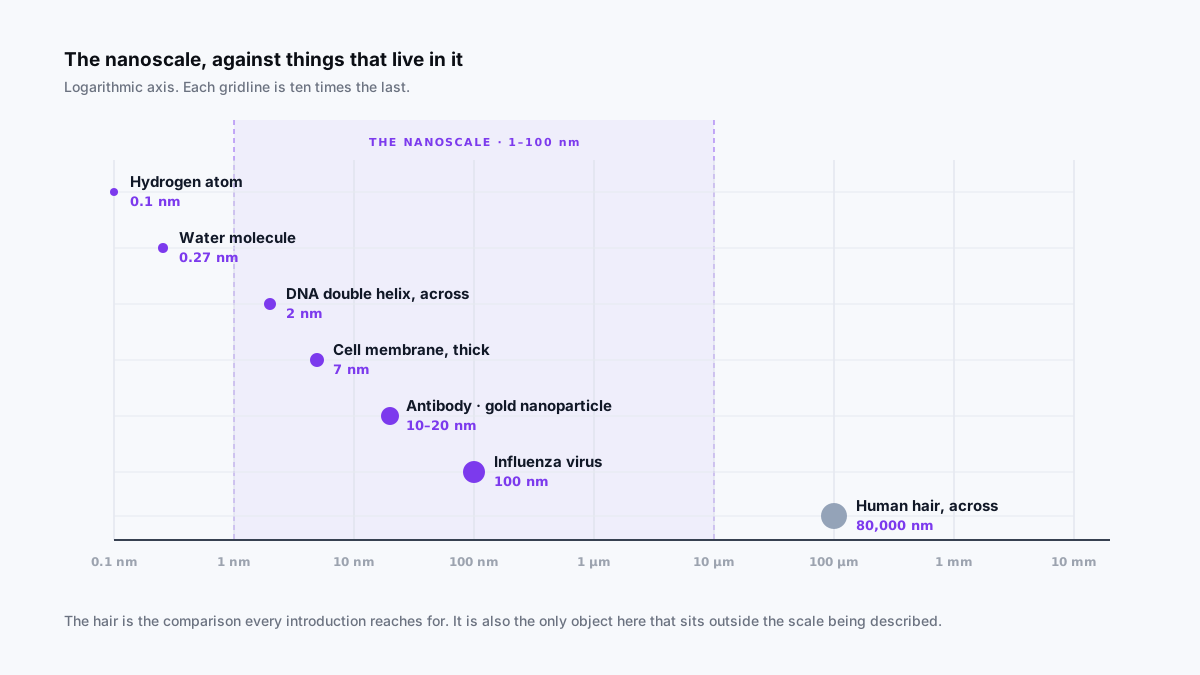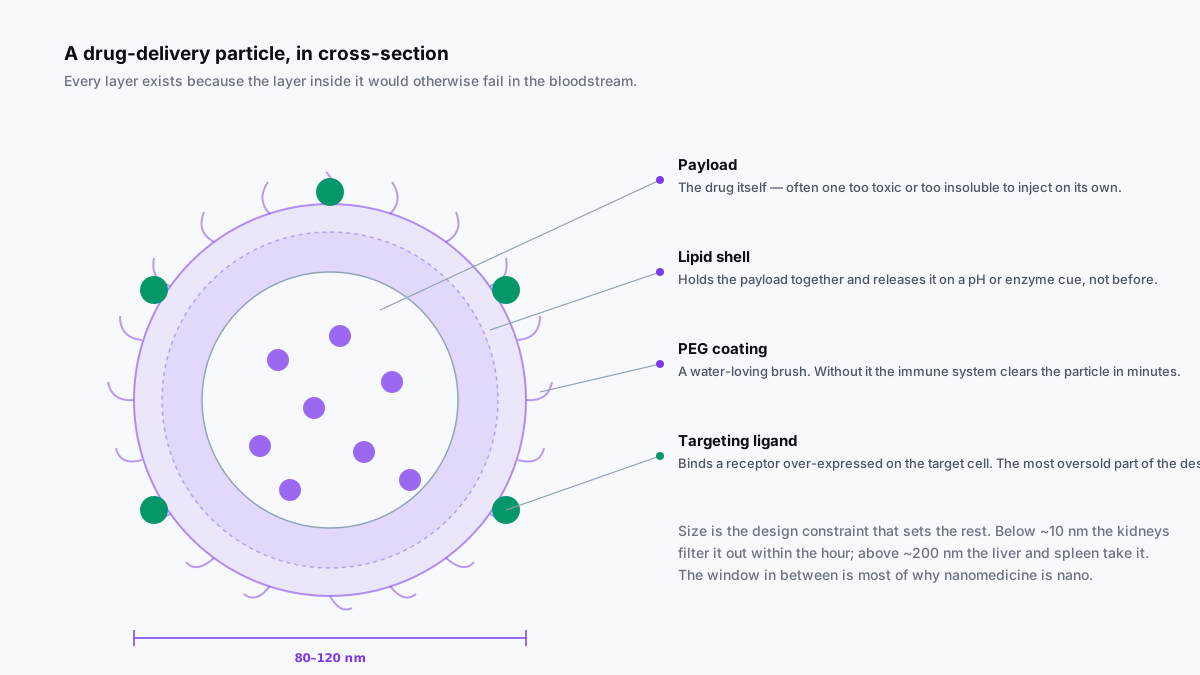
Nanomedicine uses nanoscale carriers to control where a drug goes and when it is released. The central problem is not making the drug but delivering it: a carrier below about 10 nanometres is filtered out by the kidneys within the hour, and above about 200 nanometres the liver and spleen remove it. The narrow window in between is most of the reason nanomedicine is nano.
- Delivery is the problem, not potency. Many effective compounds fail because they never reach the tissue in a usable concentration.
- Size sets everything else. Below ~10 nm the kidneys clear it; above ~200 nm the liver and spleen do.
- A PEG coat buys circulation time. Without one, the immune system tags and removes the particle within minutes.
- Targeting ligands are the most oversold layer. They improve uptake once a particle is already near the target; they do not steer it there.
The problem is not the drug
A common assumption about pharmacology is that the hard part is finding a molecule that does something useful. Frequently it is not. A great many compounds kill cancer cells reliably in vitro. The difficulty is getting them to the tumour at a concentration that works, without reaching everything else at a concentration that harms.
Three obstacles stand in the way, and each one drove a layer of the design that follows. The compound may be insoluble in blood. It may be cleared before it arrives. And it will distribute everywhere, so the dose that treats the target also poisons the patient — which is what conventional chemotherapy is.
Nanomedicine attacks all three by not injecting the drug. It injects a carrier.
Layer one: the payload and the core
At the centre sits the drug itself, held in a core that solves solubility outright. A hydrophobic compound that would precipitate in blood sits in an environment it tolerates and is carried by a particle that the blood does tolerate.
This alone is a substantial win, and it is the reason several early nanomedicines exist. It is not the interesting part.
Layer two: the shell, and the release problem
A carrier that holds a drug perfectly is useless, because the drug has to come out. A carrier that leaks is worse than no carrier, because the drug comes out everywhere.
The shell — usually a lipid bilayer or a degradable polymer — is engineered to release its payload on a cue that the target tissue provides and healthy tissue does not. In practice: tumour interstitium is more acidic than blood, so a pH-sensitive shell opens there; some tissues over-express particular enzymes, so a shell with a cleavable linker opens where that enzyme is.
This is where a great deal of formulation work sits, and where the failures are quiet. A shell that releases 30% of its payload in circulation has undone most of the benefit before arriving.
Layer three: PEG, and why circulation time is everything
An uncoated particle injected into blood is coated within seconds — by plasma proteins, which adsorb onto any foreign surface. That protein layer is a flag. Phagocytes recognise it and clear the particle to the liver and spleen, often within minutes.
The standard answer is a brush of polyethylene glycol on the surface: a water-loving polymer that holds a hydration shell and physically obstructs protein adsorption. A PEGylated particle can circulate for hours rather than minutes.
Hours matter because delivery to a tumour is largely a numbers game. Each pass through the circulation gives some fraction of the dose an opportunity to leave the bloodstream at the target. More passes, more accumulation. Circulation time is the multiplier on everything else in the design.
Layer four: targeting, and an honest account of it
The outermost layer is a ligand — an antibody fragment, a peptide, a small molecule — chosen to bind a receptor over-expressed on the target cell.
This is the layer that features most prominently in press coverage and delivers least. The reason is worth understanding, because it recurs across the field.
A targeting ligand does not steer. A nanoparticle in the bloodstream has no propulsion and no navigation; it goes where the flow takes it. The ligand only does anything once the particle is already close enough to the target to encounter its receptor. What targeting improves is uptake at the destination — getting the particle taken inside the cell rather than sitting outside it — which is real and useful and is not what "targeted delivery" suggests to a general reader.
Getting the particle near the target in the first place is done by circulation time and by the leakiness of tumour vasculature, not by the ligand. Which is why the field's honest position has shifted considerably over two decades: passive accumulation is less efficient than early results suggested, and active targeting improves the last step rather than the journey.
Where the field actually succeeded
The clearest success of nanomedicine to date is not oncology. It is the lipid nanoparticle used to deliver mRNA.
mRNA is a nearly ideal case for a carrier. It is large, negatively charged, and destroyed by enzymes in blood within minutes — it has no chance of reaching a cell unprotected. A lipid nanoparticle solves the whole problem at once: it protects the cargo, carries it into the cell, and escapes the endosome so the cargo reaches the cytoplasm intact.
The delivery vehicle was the bottleneck for mRNA therapeutics for twenty years. When it was solved, the platform arrived very quickly — which is a good illustration of what nanomedicine is actually for.
Sources & further reading
- Wilhelm, S. et al. — Analysis of nanoparticle delivery to tumours. Nature Reviews Materials 1, 16014 (2016). The paper that reset expectations on delivery efficiency. Link →
- Mitchell, M. J. et al. — Engineering precision nanoparticles for drug delivery. Nature Reviews Drug Discovery 20, 101–124 (2021). Link →
- Hou, X. et al. — Lipid nanoparticles for mRNA delivery. Nature Reviews Materials 6, 1078–1094 (2021). Link →
Common questions
Are nanomedicines already approved?
Yes. Liposomal doxorubicin has been in clinical use since 1995, albumin-bound paclitaxel since 2005, and lipid nanoparticle mRNA vaccines since 2020. The category is decades old.
Why is targeted cancer delivery still hard?
Because getting a particle near a tumour depends on circulation and vascular leakiness rather than on the targeting ligand, and both vary enormously between tumours and between patients. The variability, more than the mechanism, is the obstacle.
Do nanoparticles accumulate in the body?
Most are cleared through the liver and spleen or filtered by the kidneys, and clearance is a design requirement rather than an afterthought. Materials that persist — some inorganic cores — face a substantially harder regulatory path for that reason.
What background does nanomedicine need?
It sits between three fields. Formulation chemistry, cell biology, and enough pharmacokinetics to reason about what the body does to the carrier. Most people arrive from one of the three and learn the other two.