Machine learning has changed three things in biology: predicting protein structure from sequence, ranking candidate molecules before synthesising them, and running laboratory protocols without a human at the bench. In each case the model narrows a search rather than settling a question — a prediction is a hypothesis with a confidence score attached, and the loop still closes in a laboratory.
- Structure prediction is largely solved for the easy case. Single, well-folded, soluble proteins. Disordered regions and complexes are not.
- A confident prediction is not evidence of function. Confidence scores are calibrated on the training distribution and not outside it.
- Screening narrows, it does not decide. A hundred candidates instead of a hundred thousand is the whole value, and it is a large one.
- Automation compressed the pipetting, not the biology. Cell culture takes the time cell culture takes.
Three things, routinely conflated
"AI in biology" covers at least three separate activities with different maturities, different evidence standards and different failure modes. Treating them as one is the source of most confused coverage.
They are: predicting a structure from a sequence, ranking candidate molecules before you make any of them, and running physical laboratory work without a person present. Each deserves its own account.
Structure prediction: a real result, precisely bounded
Protein folding — the mapping from a chain of amino acids to the three-dimensional shape that determines its function — was a fifty-year open problem. It is now, for an important class of proteins, solved to accuracy comparable with experiment.
That is a genuine scientific result and it is worth stating what it covers. It works well for single, well-folded, soluble proteins with reasonable evolutionary coverage in the sequence databases. It works considerably less well for intrinsically disordered regions — which are not a rare edge case, they are a large fraction of the human proteome — for multi-chain complexes, and for anything whose conformation depends on what it is currently bound to.
The subtler point concerns confidence. Modern predictors emit a per-residue confidence score, and those scores are well calibrated on the distribution the model was trained on. Outside it they are not, and there is no signal in the output that tells you which situation you are in.
And a structure is not a function. Knowing a protein's shape narrows the hypotheses about what it does. It does not establish what it does, which still requires an assay.
Virtual screening: narrowing, which is the point
The second application is ranking. Given a target site, computationally dock millions of candidate molecules and rank them by estimated binding affinity.
The honest framing is that this is a filter, not an oracle. Docking scores correlate with measured affinity weakly enough that the absolute numbers should not be trusted. What they do reliably is enrich: the top-ranked thousand contains far more real binders than a random thousand would.
That is enough to be transformative, because synthesis and assay are the expensive steps. Testing a hundred candidates instead of a hundred thousand changes what a small group can attempt. The mistake is reading the ranking as a result rather than as a shortlist.
Laboratory automation: the constraint people expect it to remove
The third application is physical. Liquid handlers, plate readers and robotic arms under program control, with a model choosing the next experiment based on the last one's result.
This does compress a real bottleneck — a technician's day of pipetting becomes an unattended overnight run, with better reproducibility because a robot does not get tired at four in the afternoon.
What it does not compress is the biology. A culture that needs seventy-two hours needs seventy-two hours whether a person or a robot set it up. A transformation efficiency does not improve because the plate was handled by a machine. Automation raises throughput per person; it does not shorten the loop.
This is why "self-driving laboratory" claims deserve a specific question: what is the cycle time, and what set it? If the answer is the incubator, the automation has changed the labour cost and not the schedule.
The loop, and why it is the whole story
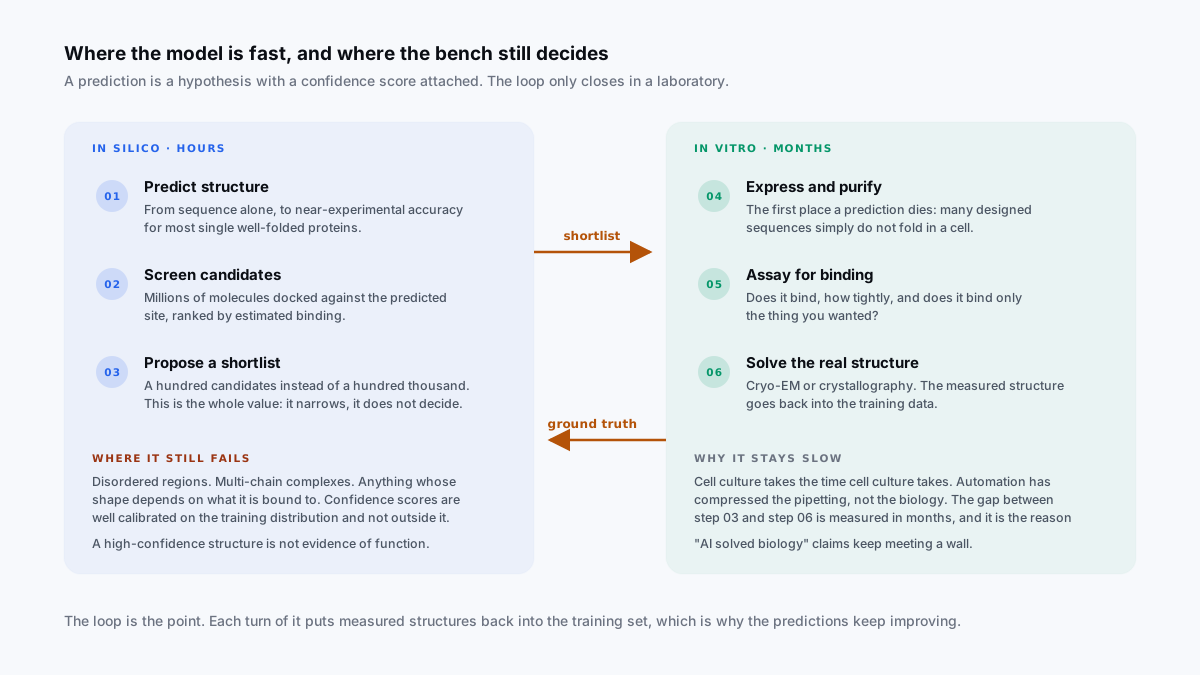
Put the three together and the shape becomes clear. The computational side runs in hours: predict a structure, dock a library, rank a shortlist. The experimental side runs in months: express the protein, purify it, assay for binding, solve the real structure.
Everything interesting happens in the traffic between them. The shortlist crosses one way; ground truth crosses back. And the return leg is the one that matters most, because every measured structure and every measured affinity becomes training data. The reason predictions have improved so quickly is that the field has been feeding decades of accumulated experimental structures into models — a resource that took fifty years of crystallography to build and can only be extended at the speed of a laboratory.
What this means for what you should learn
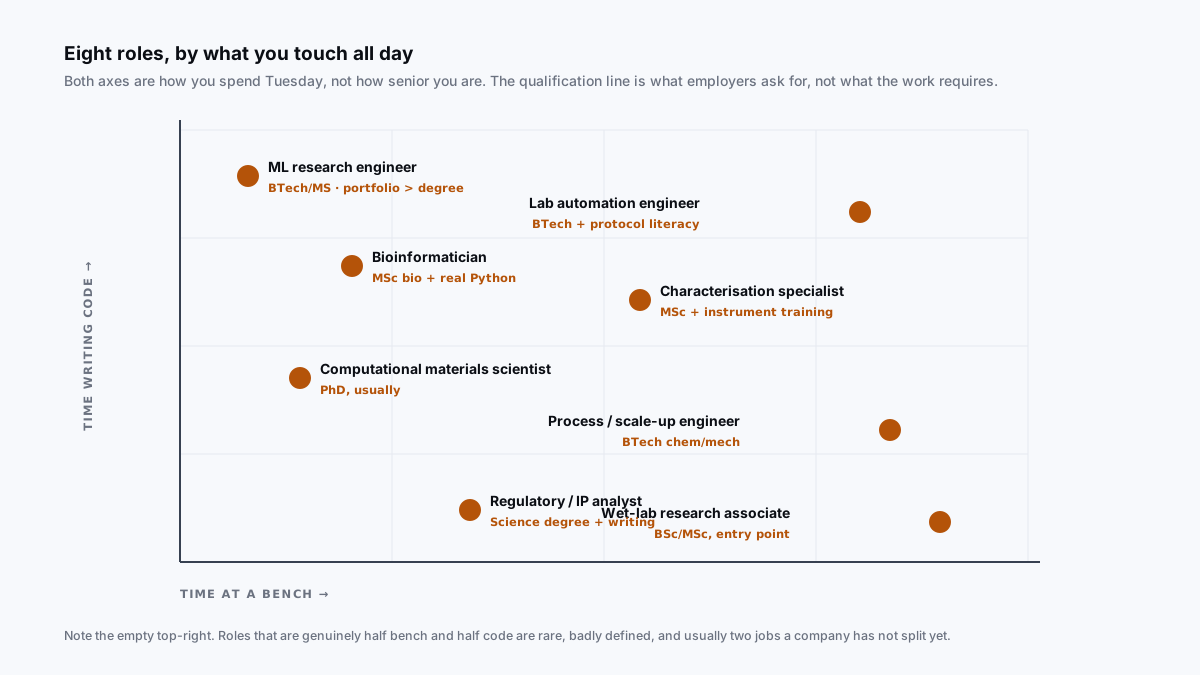
The valuable position is not on either side. It is the ability to move between them: enough computational skill to run the models and read their uncertainty honestly, and enough experimental grounding to know what a prediction would have to be worth before you spend three months testing it.
That combination is uncommon, which is precisely why it is worth having. A computational biologist who has never watched an experiment fail tends to over-trust a confidence score; a bench scientist who treats the model as a black box cannot tell a useful shortlist from a meaningless one.
Sources & further reading
- Jumper, J. et al. — Highly accurate protein structure prediction with AlphaFold. Nature 596, 583–589 (2021). Link →
- Ruff, K. M. & Pappu, R. V. — AlphaFold and Implications for Intrinsically Disordered Proteins. J. Mol. Biol. 433 (2021). On where prediction does not reach. Link →
- Watson, J. L. et al. — De novo design of protein structure and function with RFdiffusion. Nature 620, 1089–1100 (2023). Link →
Common questions
Has AI made experimental structural biology obsolete?
No — the opposite dependency holds. Predictors are trained on experimentally determined structures, so extending their reach requires more experiments, particularly for the classes they currently handle badly.
Can a model design a new protein from scratch?
Yes, and designed proteins that fold and function as intended have been demonstrated. Success rates vary widely by target, and the first place a design fails is usually expression — many designed sequences simply do not fold in a cell.
Do I need a biology degree to work in this area?
Many people arrive from computer science or physics. What is not optional is enough biology to know what a result means — a model that predicts a number nobody can interpret is not a contribution.
Is drug discovery actually faster because of this?
The early stages are demonstrably faster and cheaper. Clinical trials, which are most of the cost and nearly all of the time, are unchanged — so total time from idea to approved drug has moved much less than early-stage speedups suggest.