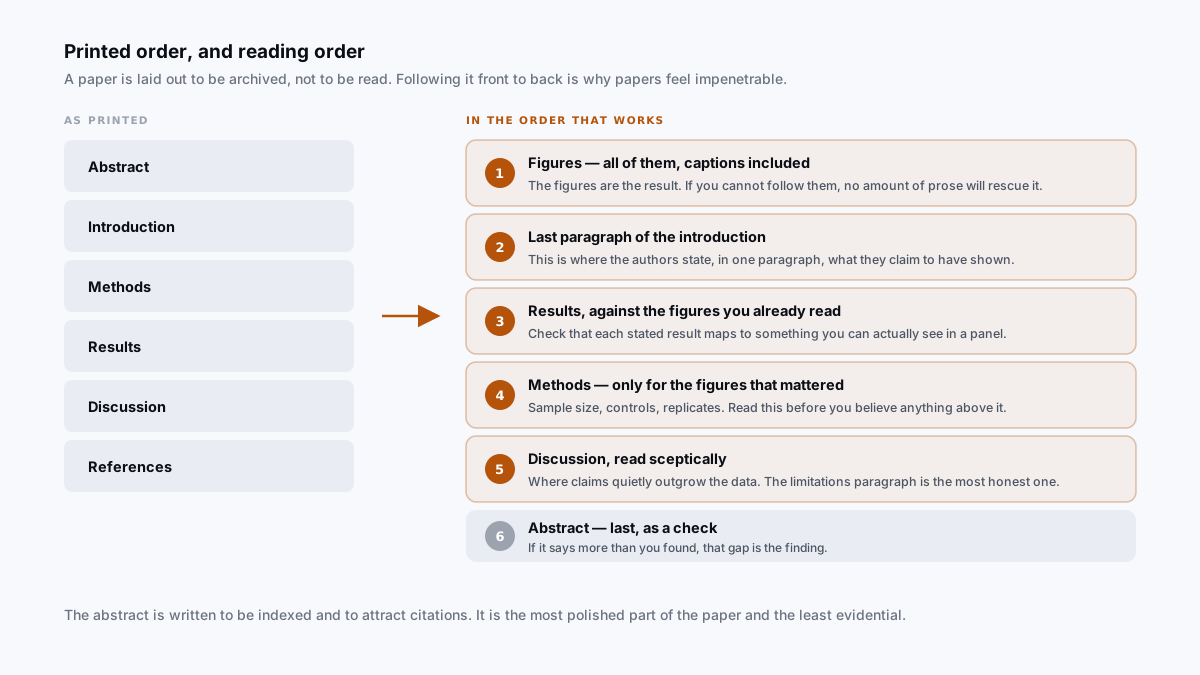
Read a paper out of order: figures and captions first, then the last paragraph of the introduction, then the results against the figures, then the methods for the figures that mattered, then the discussion sceptically, and the abstract last as a check. The abstract is the most polished part of a paper and the least evidential.
- Figures first, always. The figures are the result. If you cannot follow them, the prose will not rescue it.
- The claim lives in the last paragraph of the introduction. That is where the authors state, plainly, what they say they have shown.
- Methods before belief, not after. Sample size, controls and replicates decide what the figures are worth.
- Read the abstract last. If it claims more than you found, that gap is itself the finding.
Why papers feel impenetrable
The structure of a scientific paper — abstract, introduction, methods, results, discussion — was standardised for archiving and retrieval. It is a filing format. It was never designed for someone trying to work out, in twenty minutes, whether a result is real and whether it matters to them.
Reading it front to back means encountering the methods before you know which methods matter, and the abstract's claims before you have any basis to weigh them. Experienced readers do not do this. They read in a different order, and the order is learnable.
The order that works
1. Every figure, with its caption
Start here. In an experimental paper the figures are the result; the prose is commentary on them. Read each caption in full — captions are dense, carefully written, and frequently contain the sample size and statistical test that the main text omits.
If you cannot follow the figures, no amount of text will rescue the situation, and that is useful information about whether this paper is currently readable for you.
2. The last paragraph of the introduction
Almost universally, this is where the authors state what they claim to have shown. Usually it begins "Here we show" or "In this work we demonstrate". One paragraph, and it is the claim you are going to evaluate.
The rest of the introduction is background, and you can skip it unless the field is new to you.
3. Results, against the figures you have already read
Now read the results, checking each stated finding against a figure panel you can actually see. The specific thing to watch for is a claim in the text that no panel supports — a result described as "clear" or "marked" with nothing to point at.
4. Methods, but only for the figures that mattered
Methods sections are long and most of any one is irrelevant to what you care about. Go to the parts underlying the two or three figures the claim rests on, and read those properly.
5. Discussion, sceptically
The discussion is where claims quietly outgrow the data. It is also where the authors, who know the work better than anyone, tell you its limitations — usually in a paragraph near the end, and usually the most honest paragraph in the paper.
6. The abstract, last, as a check
Now read the abstract. If it claims more than you found, that gap is itself a finding — about the paper, and about how it will be reported by anyone who read only this far.
Four questions that do most of the work
You do not need domain expertise to apply these. They catch a large share of weak papers in any field.
How many?
Sample size, replicates, and whether replicates are biological or technical. Three technical replicates of one sample tell you about the instrument's precision, not about the phenomenon. This distinction is a large fraction of what goes wrong in published work.
Compared with what?
Every effect is an effect relative to a control, and the control determines what the number means. A treatment that outperforms nothing at all is a much weaker claim than one that outperforms the current standard.
How big, not just how significant?
A p-value below 0.05 says the effect is unlikely to be zero. It says nothing about whether the effect is large enough to matter. With a large enough sample, trivial effects become statistically significant. Always find the effect size and its confidence interval.
Would this have been published if it had failed?
If not, you are looking at a literature filtered for positive results, and the individual paper cannot tell you how many attempts preceded it. This is why reproducibility is a property of a literature rather than of a paper.
Two practical notes
Preprints. Increasingly normal in physics, biology and machine learning, and often the fastest route to current work. Read one exactly as you would read a submitted manuscript: it may be excellent, and no independent reader has yet been obliged to look for its flaws.
Peer review is a filter, not a guarantee. Reviewers rarely see raw data and essentially never repeat experiments. They check that the reasoning is sound and that the claims are supported by what is presented. "Published in a good journal" means it passed that check. It does not mean it is true, and treating it as though it does is the most common error non-specialists make with the literature.
Sources & further reading
Common questions
How long should reading a paper take?
A screening pass — figures, the claim, and whether it matters to you — takes ten to twenty minutes. A paper you intend to build on takes hours, and usually more than one sitting.
What if I do not understand the methods at all?
Read the figures anyway and note precisely what you could not follow. That list is a study plan. Most people who avoid the literature avoid it because they expect to understand everything on a first pass.
Should I trust review articles instead?
For orientation in a new field, yes — a good review is the fastest map available. For a specific claim, no: reviews compress, and compression is where nuance and caveats are lost.