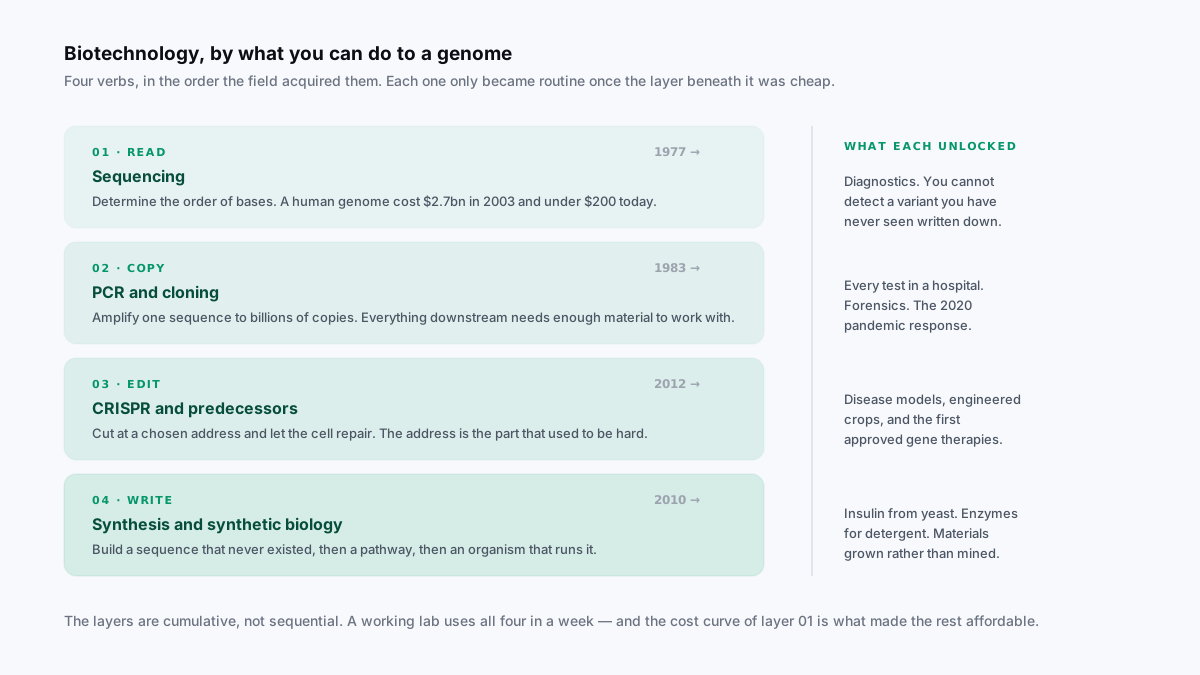
Biotechnology is the use of living systems and their components to make products or solve problems. Modern biotechnology is best understood as four capabilities acquired in sequence — reading DNA (sequencing), copying it (PCR), editing it (CRISPR and its predecessors) and writing it from scratch (synthesis) — where each capability only became routine after the cost of the one before it collapsed.
- The cost of reading DNA is the field's driving variable. A human genome went from about $2.7 billion to a few hundred dollars in twenty years.
- Editing was never limited by cutting. Restriction enzymes have cut DNA since the 1970s. CRISPR changed how you specify where.
- The cell decides what happens after the cut. Two repair pathways, and the precise one is active only in dividing cells and only at low efficiency.
- Writing is the newest and the least mature layer. Synthesis is routine at gene scale and still difficult at genome scale.
An old field with a recent discontinuity
Biotechnology in the broad sense is thousands of years old — brewing, baking, cheese-making and selective breeding all use living systems to make something. That definition is true and not very useful, because it puts a Neolithic farmer and a gene therapy in the same category.
The discontinuity is recent and specific. From the 1970s onward it became possible to work with genetic material directly: to read a sequence, copy it, move it between organisms, change it, and eventually to write one that never existed. Everything that distinguishes modern biotechnology follows from those four capabilities.
They are worth taking in the order the field acquired them, because each one is built on the one before.
Read: sequencing
Sequencing determines the order of bases in a stretch of DNA. Sanger's method arrived in 1977 and dominated for twenty-five years; the Human Genome Project used it, took thirteen years and cost around $2.7 billion.
The number that matters is what happened next. Massively parallel sequencing arrived in the mid-2000s and the cost per genome fell faster than semiconductor cost per transistor over the same period. A whole human genome is now a few hundred dollars and about a day.
Almost everything modern biology looks like is downstream of that curve. You cannot detect a variant you have never seen written down, so diagnostics needed reading first. You cannot design a guide RNA without knowing the target sequence, so editing needed reading first. Cheap sequencing is the enabling layer, and it is why a field that had been slow for decades became fast in about ten years.
Copy: PCR
Reading, editing and assaying all require more material than a sample contains. PCR solves that: a cycle of heating and cooling that doubles a chosen sequence each round, turning one copy into billions in a couple of hours.
It is the least glamorous of the four and arguably the most load-bearing. Nearly every diagnostic test in a hospital depends on it, forensics depends on it, and the global testing response of 2020 was PCR at scale.
Edit: CRISPR, and what it actually changed
This is the layer that is most often described wrongly, and the correction is genuinely clarifying.
Cutting DNA was never the hard part. Restriction enzymes have cut DNA at specific sequences since the 1970s, and earlier editing tools — zinc-finger nucleases, TALENs — worked. They were simply impractical: retargeting one meant engineering a new protein, which took a specialist team months.
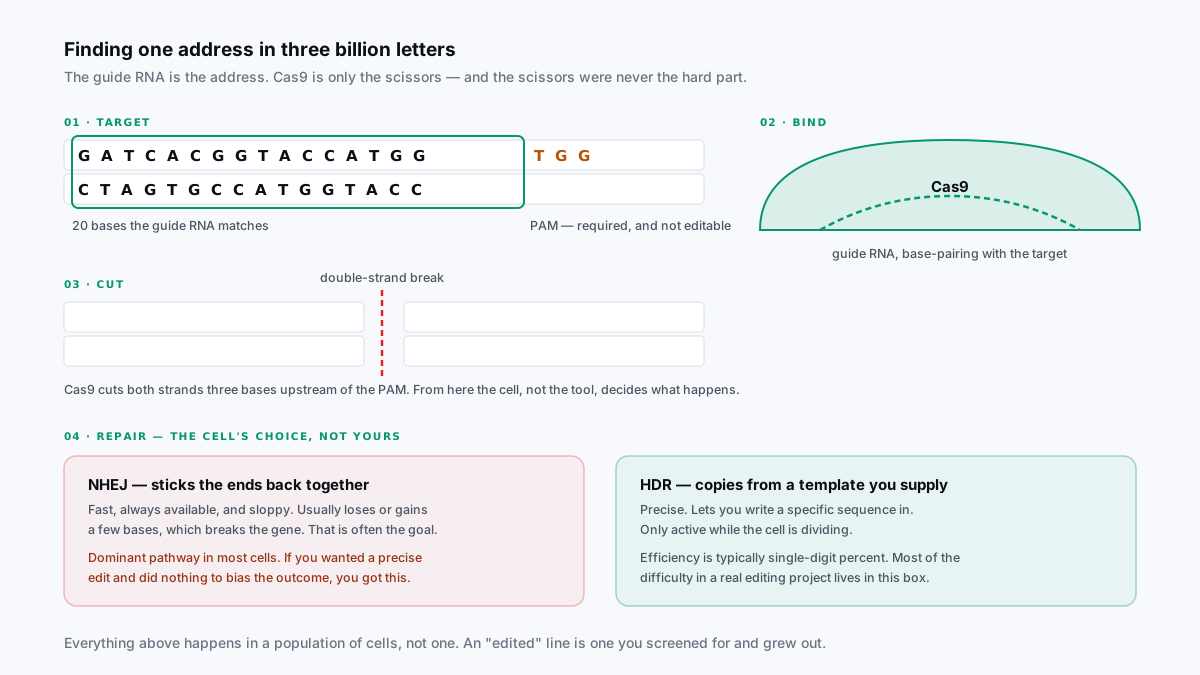
What CRISPR changed is addressing. The target is specified by a roughly twenty-base guide RNA that you can order from a supplier for a few dollars and receive in days. The protein stays the same; only the address changes. A capability that required a specialist team became something a graduate student does in a week.
What the tool does not do
Cas9 cuts. It does not write. Everything after the cut is performed by the cell's own repair machinery, and the cell chooses which pathway to use.
Non-homologous end joining sticks the broken ends back together, is fast, is always available, and is sloppy — it usually loses or gains a few bases, which breaks the gene. Frequently that is exactly the goal. Homology-directed repair copies from a template you supply and lets you write in a specific sequence, but it operates only in dividing cells and typically at single-digit percent efficiency.
So a precise edit means treating a population of cells, screening for the small fraction that repaired the way you wanted, and growing those out. "We edited the gene" describes a screening campaign, not a single operation.
Write: synthesis and synthetic biology
The newest layer, and the least mature. Chemical synthesis of DNA lets you order a sequence that has never existed. At the scale of a single gene this is routine and cheap. At the scale of a genome it remains a substantial project — a small bacterial genome has been synthesised and assembled, and it took years.
Synthetic biology is the engineering framing applied on top: standard parts, characterised behaviour, and composition of parts into systems. The results are real — insulin from engineered yeast, enzymes for detergent, artemisinin precursors from engineered microbes — and the founding metaphor over-promised, because biological parts do not compose as cleanly as electronic ones. A promoter characterised in one strain frequently behaves differently in another.
The layer that is easy to skip
There is a fifth capability that is not a laboratory technique and stops more projects than any of the four above: the legal and regulatory layer.
A modified organism, a sequence, a diagnostic method and a therapeutic use can each be the subject of intellectual property, and the answer to "who owns this" is frequently not simple. A therapy also has to clear a regulatory pathway that will demand years of evidence and cost more than the research did.
Researchers who learn only the wet-lab layer are repeatedly surprised by this. It is not an obstacle bolted on at the end — it shapes which projects are worth starting.
Sources & further reading
- WIPO — A Primer on Technology Transfer in the Field of Biotechnology: What is Biotechnology? Link →
- Jinek, M. et al. — A Programmable Dual-RNA-Guided DNA Endonuclease in Adaptive Bacterial Immunity. Science 337, 816–821 (2012). Link →
- National Human Genome Research Institute — The Cost of Sequencing a Human Genome. Link →
- Iberdrola — What is biotechnology and what is it used for? A concise sector overview. Link →
Common questions
Is genetic engineering the same as biotechnology?
Genetic engineering is one part of it. Biotechnology also covers fermentation, enzyme production, diagnostics and bioprocessing, much of which involves no genetic modification at all.
What are the 'colours' of biotechnology?
An informal convention: red for medical, green for agricultural, white for industrial, blue for marine. It is a useful shorthand for sectors and carries no technical meaning.
How accurate is CRISPR?
On-target cutting is efficient. Off-target cutting at sequences similar to the guide is the standard concern and is measurable — modern guide design and higher-fidelity Cas variants reduce it substantially but do not eliminate the need to check.
Can I learn biotechnology without laboratory access?
The computational half — bioinformatics, sequence analysis, structure prediction — genuinely yes, and it is a real career path. The wet-lab half needs a bench, and no amount of theory substitutes for having handled a pipette badly and learned why it mattered.