CRISPR uses a short guide RNA to locate a specific twenty-base sequence in a genome and an enzyme, usually Cas9, to cut both DNA strands there. Cutting DNA was already routine; what CRISPR changed is that the target is specified by an RNA sequence you can order rather than by engineering a new protein for every site.
- The innovation is addressing, not cutting. Restriction enzymes have cut DNA at specific sequences since the 1970s.
- A guide RNA costs a few dollars. Earlier tools required engineering a new protein per target — months of specialist work.
- The cell chooses the repair pathway. The sloppy one is fast and always available; the precise one works only in dividing cells at low efficiency.
- PAM is a constraint you cannot design away. No PAM next to your target means no cut with that enzyme.
What was actually hard
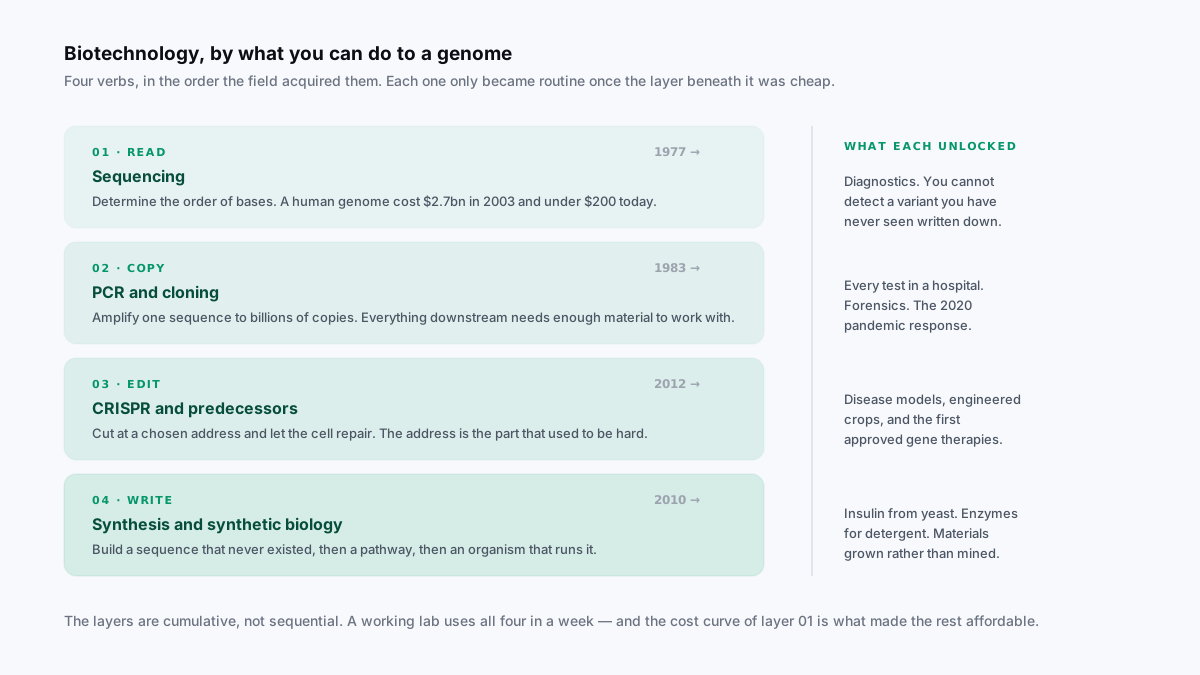
The usual account of CRISPR describes it as molecular scissors, which is accurate and hides the point. Cutting DNA was never the difficulty. Restriction enzymes have cut DNA at specific sequences since the 1970s, and the gene-editing tools that preceded CRISPR — zinc-finger nucleases, TALENs — worked perfectly well.
They were impractical. Retargeting one meant engineering a new protein, and that took a specialist team months and a great deal of money for a single site.
What CRISPR changed is addressing. The target is specified by a roughly twenty-base guide RNA that you order from a supplier for a few dollars and receive in days. The protein is unchanged; only the address changes.
A capability that required a specialist team became something a graduate student does in a week. That is the whole revolution, and it is a revolution in logistics rather than in biochemistry.
Finding one address in three billion letters
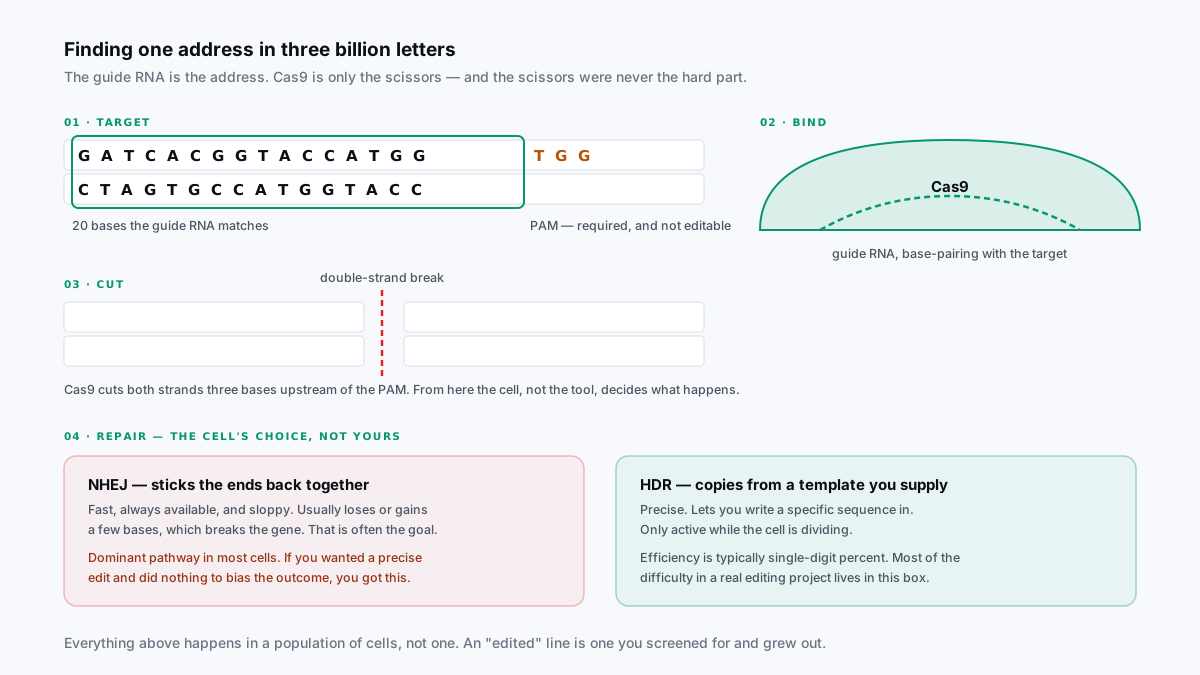
The guide RNA is complementary to the target sequence, so it base-pairs with it in the way DNA base-pairs with DNA. Cas9 carries the guide, samples sites across the genome, and cuts where the match holds.
There is one constraint that catches people out. Cas9 will not cut unless it finds a short sequence called a PAM immediately next to the target — for the common Cas9, that is any base followed by two guanines. No PAM, no cut, regardless of how good the guide is.
This means not every position in a genome is editable with a given enzyme, and choosing a target is partly a search for a nearby PAM. Different Cas variants recognise different PAMs, which is a large part of why so many have been characterised.
The cut, and then the part that is not up to you
Cas9 cuts both strands, three bases upstream of the PAM. At that instant the tool has finished. What happens next is performed by the cell's own repair machinery, and the cell decides which pathway to use.
Non-homologous end joining
The ends are stuck back together directly. Fast, always available, and sloppy — it usually loses or gains a few bases at the junction. That shifts the reading frame and breaks the gene.
Frequently breaking the gene is exactly the goal, which is why knockouts are the easiest CRISPR experiment and the one most published results use.
Homology-directed repair
The cell copies from a template. Supply a template of your own and you can write a specific sequence in — a corrected base, an inserted tag, a whole cassette.
Two limitations make this the hard path. It operates only while the cell is dividing, so it is unavailable in most differentiated tissue. And its efficiency is typically in the single-digit percent range even where it does work.
Why "we edited the gene" describes a screening campaign
Put those efficiencies together and the practical picture changes shape. You do not edit a cell. You treat a population of cells, most of which either do not take up the machinery, or take it up and repair sloppily, or are not dividing.
Then you screen — sequence individual clones, find the small fraction that repaired the way you wanted, and grow those out. An "edited cell line" is one you selected for and expanded.
This is the single most useful thing to understand about the technique, because it explains why gene therapy in a living patient is so much harder than editing in a dish. In a dish you can afford a 3% success rate: you throw away the other 97%. In a person you cannot select, cannot discard, and have to live with whatever the population did.
Off-target effects, stated accurately
A guide sequence that matches your target may also partially match somewhere else in the genome, and Cas9 tolerates some mismatches. Cuts at those sites are off-target effects.
Three things are worth stating plainly. It is real and it is measurable — whole-genome sequencing after editing will find it. Modern guide design software checks candidate guides against the whole genome for near-matches, and high-fidelity Cas variants have substantially reduced tolerance for mismatch. And it has not been eliminated, which is why clinical applications include off-target screening as standard rather than as reassurance.
What it is genuinely used for now
Most CRISPR in the world is a research tool: knock out a gene, see what breaks, learn what the gene does. Unglamorous, enormously productive, and the reason the technique spread so fast.
In agriculture it is used to produce variants that conventional breeding could also reach, more quickly — which is also why the regulatory position on such crops differs by jurisdiction.
In medicine the first approved therapies target blood disorders, and the reason is instructive. Blood stem cells can be removed from the patient, edited in a dish where you can select for the correct edit, and returned. It sidesteps the delivery problem that makes editing inside the body so much harder.
Sources & further reading
- Jinek, M. et al. — A Programmable Dual-RNA-Guided DNA Endonuclease in Adaptive Bacterial Immunity. Science 337, 816–821 (2012). Link →
- Doudna, J. A. — The promise and challenge of therapeutic genome editing. Nature 578, 229–236 (2020). Link →
- Frangoul, H. et al. — CRISPR-Cas9 Gene Editing for Sickle Cell Disease and β-Thalassemia. NEJM 384, 252–260 (2021). Link →
Common questions
Can CRISPR edit a gene in a living adult?
In some tissues, yes — the liver in particular, because lipid nanoparticles reach it reliably. Delivery to most other tissues at useful efficiency remains the central unsolved problem.
Is CRISPR the same as genetic modification?
It is one method of genetic modification. What distinguishes it is precision of targeting: older methods inserted material at unpredictable locations, which is why regulatory treatment of the two increasingly differs.
How much does a CRISPR experiment cost?
The guide RNA and enzyme are tens of dollars. The cost is in what surrounds it — cell culture, transfection, sequencing to verify, and the screening to find correctly edited clones.