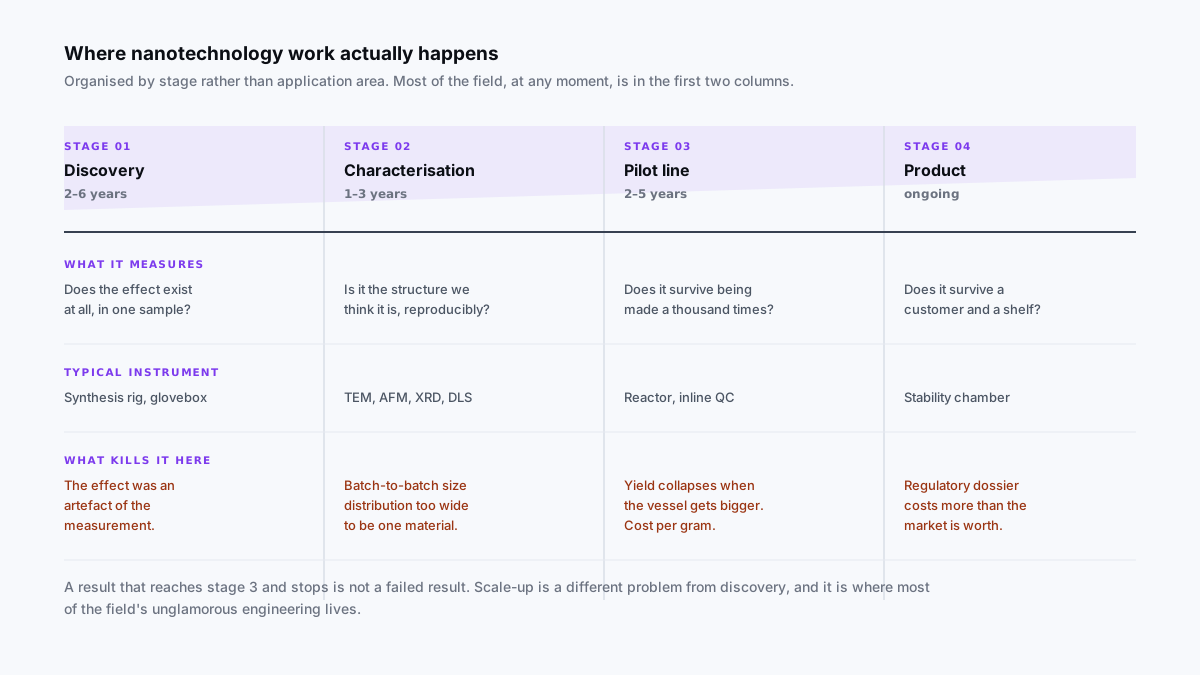
Most nanotechnology work sits in one of four stages: discovery, characterisation, pilot-scale manufacture, and product. The great majority of published results are in the first two, and the transition from characterisation to a pilot line — where a synthesis that works once has to work a thousand times with a controlled size distribution — is where most projects stop.
- Stage tells you more than field. A discovery-stage result in medicine and one in energy have more in common with each other than either has with a product.
- Characterisation is where claims die. Most of the difference between a reported and a real material is a size distribution nobody published.
- Scale-up is a separate discipline. Yields that hold in a flask routinely collapse in a reactor, for reasons of mixing and heat transfer rather than chemistry.
- A result that stops at stage three has not failed. It has reached the boundary of what discovery work is for.
Why stage beats application area
Reviews of nanotechnology are usually organised by application: medicine, energy, electronics, environment. It reads well and it obscures the thing a reader most needs, which is how far along any given result actually is.
A discovery-stage result in drug delivery and a discovery-stage result in battery electrodes share their evidence standards, their failure modes and their distance from anything usable. A drug-delivery result at product stage has almost nothing in common with either. Sorting by stage puts the comparable things together.
Stage one: discovery
The question: does the effect exist at all, in one sample, under conditions we controlled?
This is where most published papers sit and where the field's visible output is generated. A synthesis is attempted, a property is measured, and something either happened or did not. The work is genuinely creative and the evidential bar is deliberately low — it has to be, or nothing new would ever be reported.
What kills a result here: the effect was an artefact of the measurement. This is more common than the literature suggests. An apparent catalytic enhancement that turns out to be trace metal contamination from the stir bar; a fluorescence signal from the solvent rather than the particle. These are not incompetence — they are what happens at the edge of detection, which is where discovery work is done.
Stage two: characterisation
The question: is the material the structure we think it is, reproducibly, across batches?
Characterisation is where a claimed material becomes a known one, and where the largest share of nanoscience claims quietly change shape. The instruments are TEM for size and morphology, AFM for surface topography, X-ray diffraction for crystal structure, dynamic light scattering for size in suspension, and spectroscopy for composition and optical behaviour.
The recurring finding is a size distribution wider than reported. A paper says "20 nm particles"; the distribution runs from 8 to 60 nm with a mode near 20. Since almost every nanoscale property depends steeply on size, a sample like that is not one material — it is a mixture whose average behaviour tells you little about any of its components.
What kills a result here: the batches do not match each other. If the second synthesis does not reproduce the first, there is nothing to take forward regardless of how good the first was.
Stage three: the pilot line
The question: does it survive being made a thousand times, in a vessel that is not a flask?
This is the narrowest part of the funnel and the least published. Scale-up is a separate discipline from discovery, and it fails for reasons that have nothing to do with the chemistry being wrong.
Mixing is the usual culprit. A 50 ml flask on a stir plate reaches uniform concentration almost instantly; a 50 litre reactor does not. Nucleation and growth are exquisitely sensitive to local concentration and temperature, so a synthesis that produced a narrow size distribution at bench scale produces a broad one at pilot scale — the same chemistry, a different mixing regime.
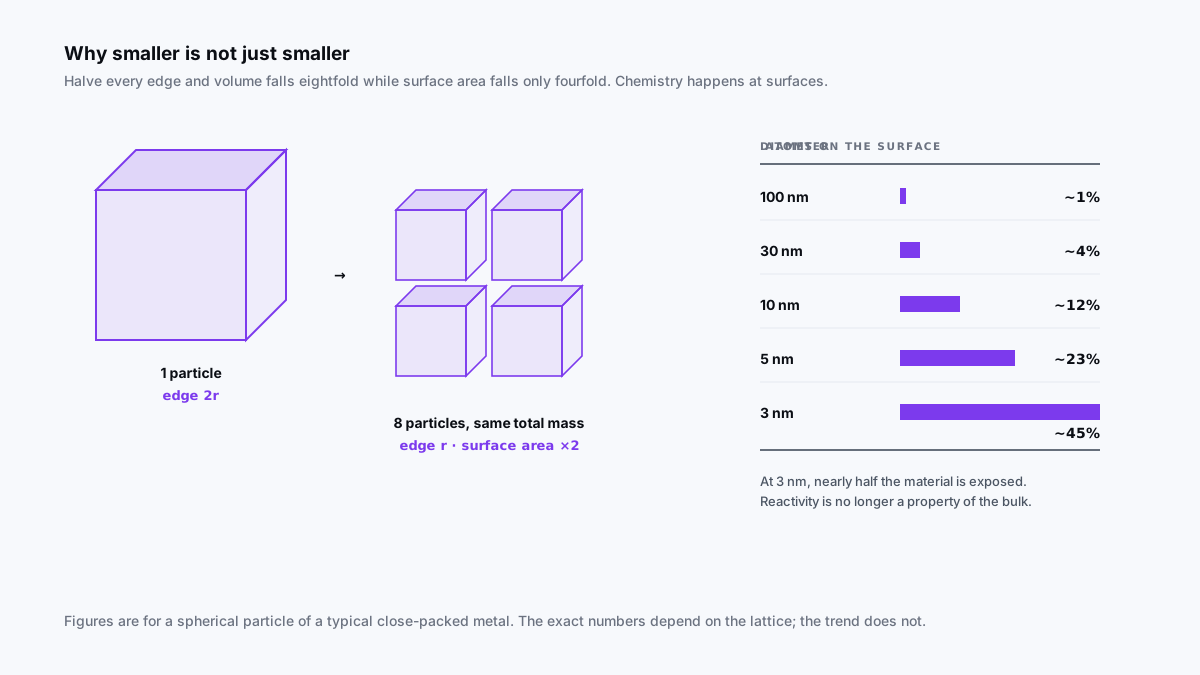
Heat transfer fails the same way. Surface area per unit volume drops as a vessel grows, so an exotherm that dissipated harmlessly in a flask now runs away.
What kills a result here: cost per gram, usually. A material that requires a rare precursor, a slow step or a low yield may be entirely real and still never be worth making.
Stage four: product
The question: does it survive a customer, a supply chain and a shelf?
Comparatively few nanomaterials get here, and the ones that have are less exotic than the field's press coverage implies: quantum dots in display panels, nanostructured electrodes in lithium cells, metal oxide particles in sunscreen, silver in antimicrobial coatings, lipid nanoparticles in vaccines, catalytic converters.
What kills a result here: the regulatory dossier. Establishing safety for a novel nanomaterial in a consumer product can cost more than the market is worth, which is a business fact rather than a scientific one and is nevertheless where several technically sound materials have ended.
How to read a paper's stage
The stage is rarely stated and is usually easy to infer.
- Sample count. "We synthesised and characterised" with no batch number is stage one. "Across five independent batches" is stage two.
- Size distribution. A histogram with a standard deviation is stage two. A single quoted diameter is stage one.
- Quantity. Milligrams is bench. Grams is a serious scale-up attempt. Kilograms is a pilot line.
- The word "potential". Density of it in the abstract correlates inversely with stage, reliably.
None of this is a criticism of early-stage work. Discovery is the point of a research laboratory, and a result that reaches stage three and stops has done what a research laboratory is for. The mistake is reading a stage-one result as though it were a stage-four one, which is what most coverage of the field does.
Sources & further reading
- Baer, D. R. et al. — Characterization challenges for nanomaterials. Surface and Interface Analysis 40 (2008). Link →
- Britannica — Nanotechnology: research and development. Overview of how the field's research is organised. Link →
- Faria, M. et al. — Minimum information reporting in bio–nano experimental literature. Nature Nanotechnology 13, 777–785 (2018). Link →
Common questions
Why do so few nanomaterials reach products?
The same reason as in any materials field, amplified by size sensitivity: properties that depend steeply on diameter demand a manufacturing control that is expensive to achieve and expensive to prove you have achieved.
Is the reproducibility problem specific to nanotechnology?
No, but it bites harder here. When a property varies with the cube of a diameter, a modest difference in preparation produces a large difference in result — so unreported details of preparation matter more than in most fields.
Which areas are moving fastest right now?
Lipid nanoparticle delivery, driven by proven regulatory pathways; battery and catalyst materials, driven by energy demand; and nanostructured membranes for separation, where the manufacturing was already solved for other reasons.
How do I get experience at the characterisation stage?
Instrument time is the constraint, not theory. Look for programmes with hands-on access to TEM, AFM and XRD — being able to operate them and read their artefacts is one of the more transferable skills in the field.