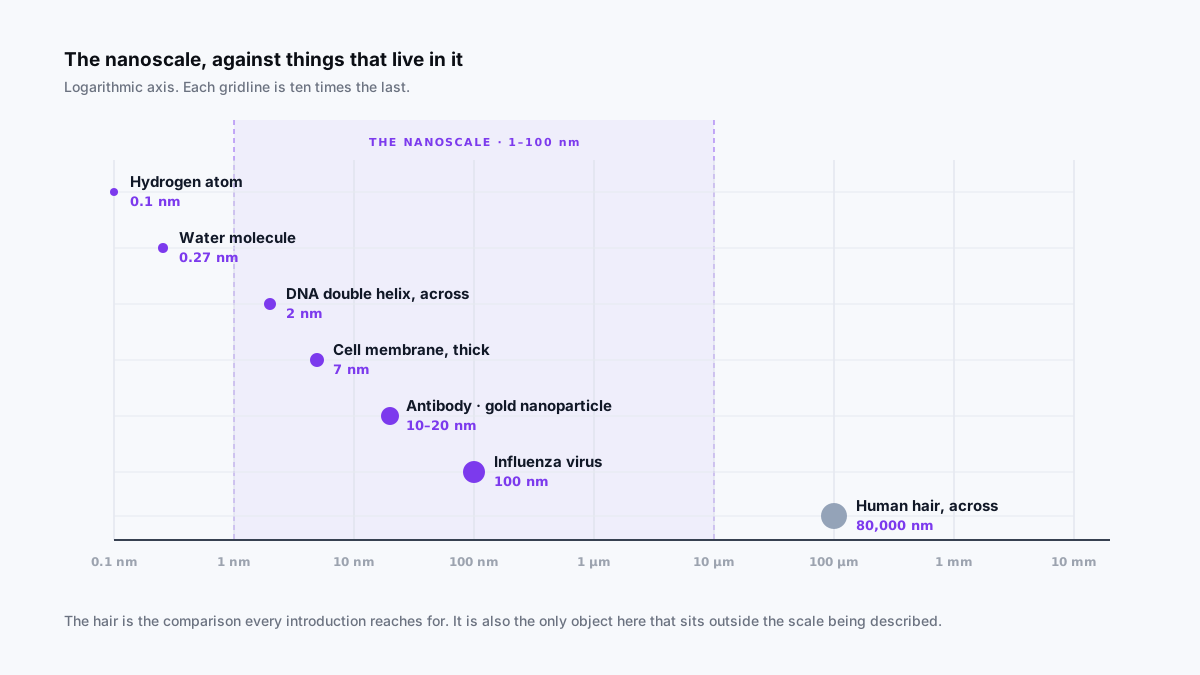
A nanometre is one billionth of a metre — about the width of ten hydrogen atoms side by side, or four water molecules. The useful comparisons are not to visible objects but to things at the same scale: DNA is 2 nm across, a cell membrane is 7 nm thick, and an influenza virus is about 100 nm.
- One nanometre is 10⁻⁹ m. A sheet of paper is about 100,000 nm thick.
- Anchor to things at the same scale. Water molecule 0.27 nm, DNA 2 nm, cell membrane 7 nm, antibody 10 nm, influenza virus 100 nm.
- Gold is the clearest demonstration. Bulk gold is yellow and inert; 20 nm gold is red and catalytically active.
- The useful range is 1–100 nm. Below it you are doing chemistry; above it bulk properties reassert themselves.
The comparison everyone uses, and why it fails
A nanometre is one billionth of a metre. Written out: 0.000000001 m — and written out is precisely the problem. The number is too far outside ordinary experience for the digits to carry any meaning.
So every introduction reaches for a comparison, and almost every one reaches for the same one: a human hair, about 80,000 nanometres across.
That comparison fails for a specific reason. It tells you a nanometre is small relative to something you can see, which you already knew. What it does not give you is any sense of where a nanometre sits relative to the things that actually operate at that scale — atoms, molecules, the machinery inside a cell. The hair is the only object in the usual diagram that lives entirely outside the scale being described.
Six comparisons that hold up
Each of these anchors the nanometre against something at or near its own order of magnitude, which is what makes them useful rather than merely dramatic.
- A single water molecule is about 0.27 nm across. Roughly four of them span a nanometre.
- The DNA double helix is 2 nm wide — a figure unchanged since Franklin's diffraction images.
- A typical protein is 3 to 10 nm. An antibody is about 10.
- A cell membrane is 7 nm thick. Nearly every drug that works has crossed one.
- An influenza virus is about 100 nm — the top of the nanoscale.
- Your fingernail grows at roughly 1 nm per second.
The last one is worth sitting with. It is the only entry on the list that converts the scale into something you have direct experience of: in the time you have spent reading this paragraph, your nails advanced by a few dozen nanometres.
Why the scale changes the physics
Here is the part the hair comparison cannot reach. Materials at this scale do not merely get smaller — they become different, for two reasons that compound.
Surfaces take over
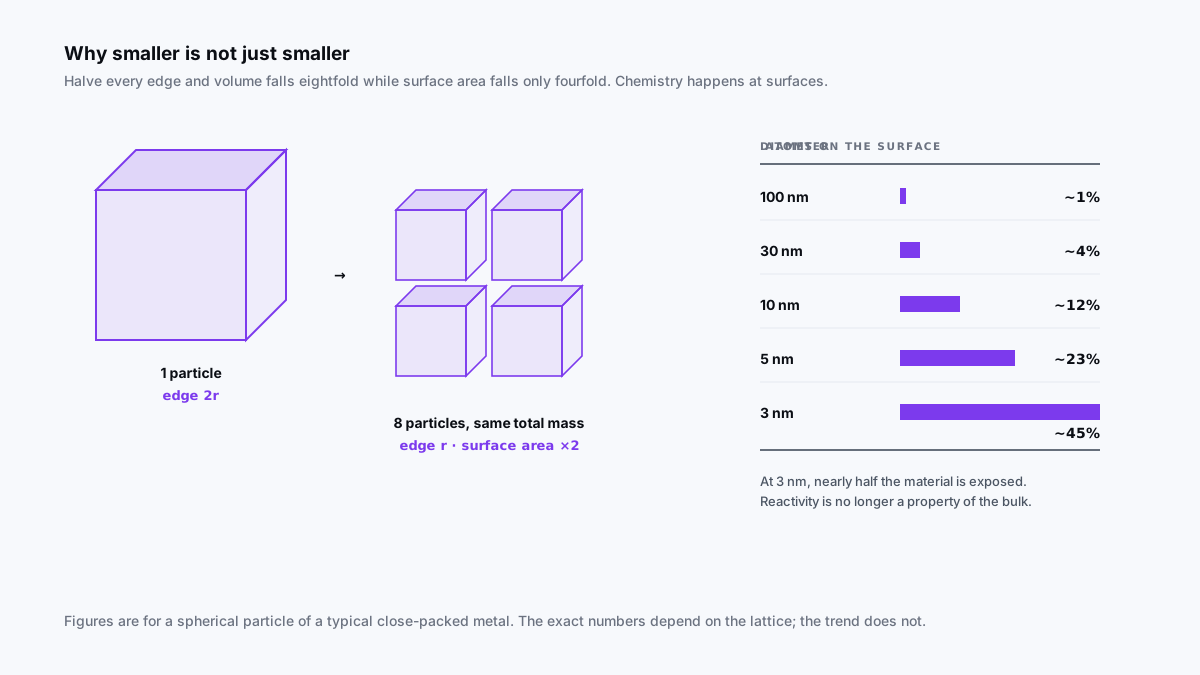
Take a cube of material and halve every edge. Volume falls by a factor of eight; surface area falls by only four. Repeat this and the fraction of atoms sitting exposed on the surface climbs from negligible to dominant.
In a 100 nm particle, roughly 1% of atoms are surface atoms. At 10 nm it is around 12%. At 3 nm, close to half the material is exposed. Since chemistry happens at surfaces, a material's reactivity can shift by orders of magnitude without a single change to its composition.
Quantum effects stop averaging out
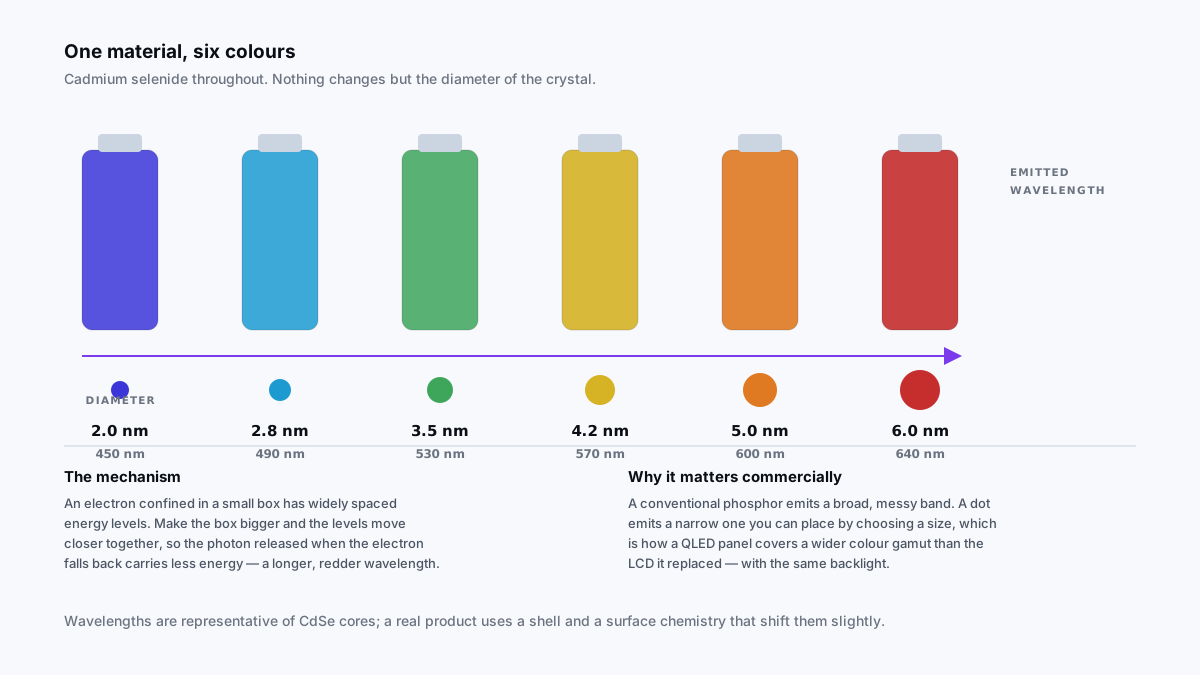
Confine electrons within a few nanometres and their permitted energy levels separate into discrete steps. In a quantum dot this means the emitted colour is set by the crystal's diameter rather than its chemistry: a 2 nm cadmium selenide dot fluoresces blue, a 6 nm dot of identical composition fluoresces red.
The gold demonstration
Bulk gold is yellow and famously unreactive — the reason it survives in jewellery for millennia without tarnishing. Gold reduced to 20 nm particles suspends in water as a deep red colloid and catalyses carbon monoxide oxidation at room temperature.
Same element. Same purity. Only the scale is different.
Michael Faraday made such a suspension in 1857, reported it to the Royal Society, and correctly attributed the colour to finely divided gold rather than to any chemical change. His original sample is still red and still at the Royal Institution, which makes it both the first nanomaterial characterised as such and an unusually good stability study.
Where the useful range begins and ends
National programmes and the research literature converge on 1 to 100 nm, and the boundaries have reasons behind them.
Below roughly 1 nm you are describing individual molecules, and the vocabulary of chemistry serves better. Above about 100 nm, surface effects thin out and bulk properties reassert themselves.
Which is why nanotechnology is a claim about a size regime rather than about any particular material — and why a nanoparticle of an entirely familiar substance can still be, functionally, a new one.
Sources & further reading
Common questions
How many atoms fit in a nanometre?
Between three and ten, depending on the element. Hydrogen atoms are about 0.1 nm across, so ten span a nanometre; larger atoms such as caesium are closer to 0.3 nm, so three or four do.
Is a nanometre the smallest useful unit?
No. The picometre (10⁻¹² m) is standard for bond lengths and the ångström (0.1 nm) remains in wide use in crystallography. The nanometre is simply the scale at which materials engineering becomes possible.
Why is 100 nm the upper limit?
It is a convention rather than a physical boundary, but a defensible one: above roughly 100 nm the surface-to-volume ratio has dropped far enough that most materials behave essentially as bulk.